


TL;DR
- Software is hard to begin with: only about 31% of projects are truly successful, 52% are challenged, and 19% are cancelled. Offshore can amplify or ease that — depending on setup.
- Roughly 60% of offshore failures trace to cultural mismatch, not skill. It's a communication-and-structure problem.
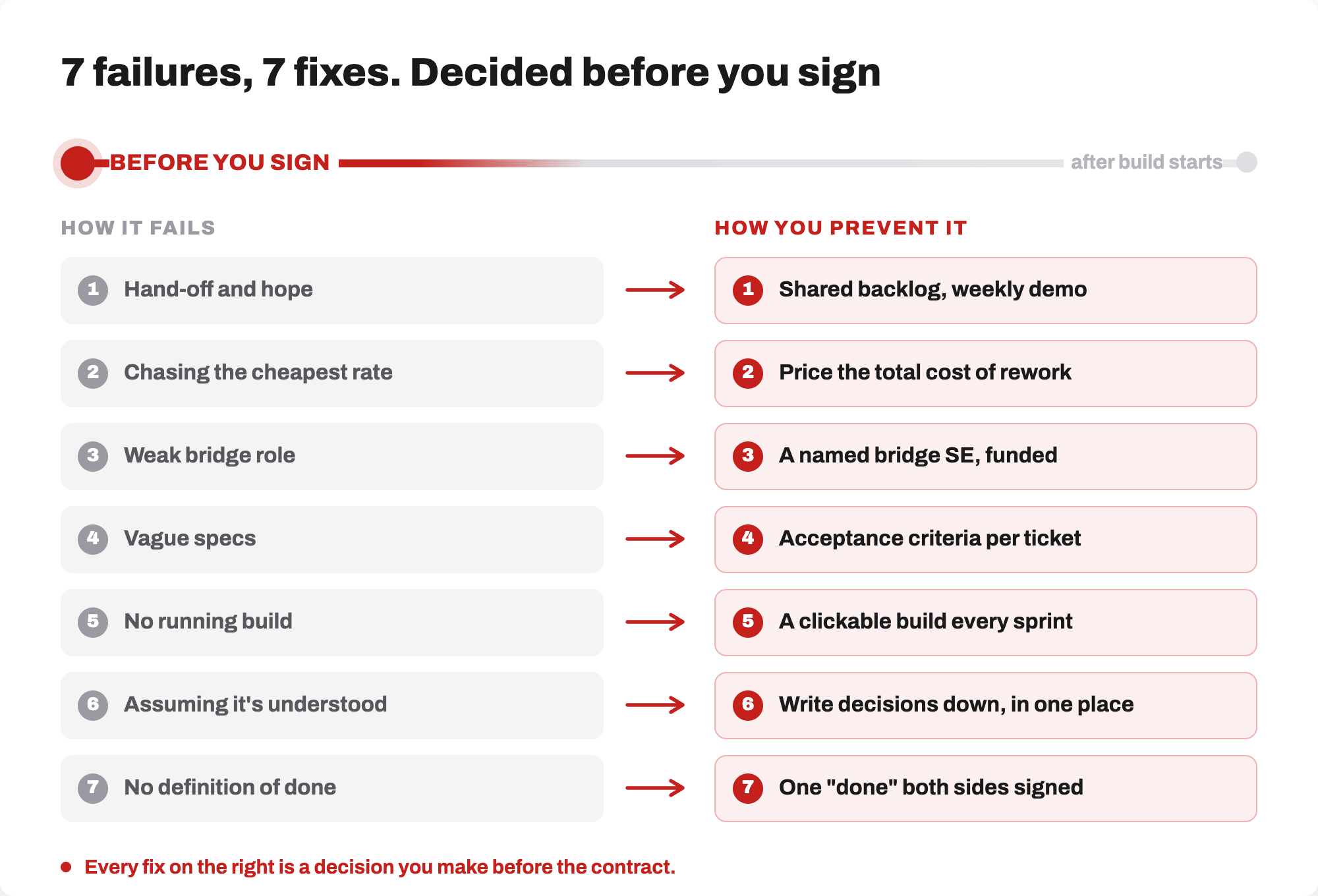
- The seven common failures: hand-off, cheapest-rate selection, weak bridge role, vague requirements, no running build, relying on unspoken understanding, no definition of done.
- Every one is avoidable — and it's avoided before you sign, in how you choose and structure the engagement.
Failed offshore projects share a script that's almost eerie in its repetition. The demo looked good. The rate was a third of a local hire. Then, months later, what came back "wasn't what we asked for." Most executives file this under "their engineers weren't good enough." But the thing that actually decided it happened much earlier — in how the work was bought.
The Standish Group's research puts truly successful projects at around 31%, with 52% challenged (over budget, late, or under-delivered) and 19% cancelled outright. Offshore adds its own failure modes on top — but that also means the failures are patterned and predictable. Here are the seven we hear most often from second-time clients, each with the fix.
1. The hand-off (turning it into a black box)
What happens: You hand over a spec and wait for delivery. Nothing is visible in between, and by the time you look, the direction has drifted.
Avoid it: demand a clickable, running build at the end of every sprint. Track progress through a URL you can open, not a status deck.
2. Choosing on rate alone
What happens: You pick the cheapest quote, then rework eats the savings. Cheaply built "wrong" is still wrong — just faster.
Avoid it: compare on review, testing, and requirements process — not the rate card. Judge total cost, rework included.
3. Underrating the bridge role
What happens: Requirements get thrown over a wall in chat. Nuance is lost, and spec drift compounds. Around 60% of offshore failures trace back to exactly this cultural mismatch.
Avoid it: make a strong bridge lead — owning requirements, translation (literal and cultural), and decisions — a non-negotiable requirement. Check for it first, not last.
4. Starting with vague requirements
What happens: "We'll figure it out later," so build starts, developers fill gaps by guessing, and the mismatch surfaces three weeks in.
Avoid it: give ambiguity an owner and write acceptance criteria before work starts. When a developer is blocked, the answer should take hours, not days.
5. Reports, but nothing that runs
What happens: The standup and the burndown chart are immaculate, yet no one has clicked what was built. "80% done" sits still for a month.
Avoid it: define "done" as "runs on staging." Measure progress in working builds, not percentages. We go deeper in our agile offshore development model.
6. Expecting the unspoken to be understood
What happens: Assumptions that "they'll just know" — the way an office runs on shared context — don't survive distance, and gaps appear.
Avoid it: make the implicit explicit. Write down assumptions, non-functional requirements, and edge cases. This isn't distrust; it's how you raise the success rate.
7. No quality bar, tests, or definition of done
What happens: You ship with undefined test criteria, bugs pile up, technical debt grows, and when a key engineer leaves, no one can fix it.
Avoid it: include testing, review, and deploy inside "done." Avoid key-person dependency by making code review and handover a system, not a favour.
The real cause behind all seven
Line them up and the pattern is obvious: not one of the seven is about engineering talent. Every one is decided before the build — in how you choose and structure the engagement. Which is the good news: they're preventable. The market reached roughly $151.9 billion in 2025, so options aren't the problem. The question was never "should we offshore" — it's "how do we set it up."
That's not just our opinion; it's baked into how we run Vietnam offshore development. And with outcome-based delivery — fee tied to the result, not the hours — the "not what we asked for" risk sits structurally with us, not you.
Frequently asked questions
What are the most common offshore development failures?
Hand-off (black box), choosing on rate alone, underrating the bridge role, vague requirements, reports without a running build, relying on unspoken understanding, and no definition of done. All are structural, not skill problems.
Why do offshore development projects fail?
The biggest single cause is cultural mismatch, which accounts for around 60% of offshore failures. Requirements and communication structure decide outcomes far more than time zones or raw skill.
Is a cheap offshore rate a red flag?
The low rate itself isn't the problem — choosing on rate alone, with no review, testing, or requirements process, is. It drives rework that makes total cost higher. Compare on process, not the rate card.
Do I really need a bridge lead to avoid failure?
Yes. One person owning requirements, translation, and decisions is the highest-ROI investment against failure. Confirm it exists before you sign.
Our project is already going sideways — can it be saved?
Usually, yes. Start with three things: a definition of done, a running build every sprint, and an owner for ambiguity. A free scoping call can diagnose where the loop is broken.
Set up an engagement that won't fail — before it starts
Book a free 30-minute scoping call. We'll tell you honestly where the risk sits in how you're buying offshore — whether you're about to start, or trying to rescue a project that's drifting.
Our promise to SME clients: system stable in 90 days, or we work free.